
A good quiz question is one that a prepared person can answer correctly and an unprepared person cannot guess. That means a stem that makes sense on its own, wrong options that reflect mistakes people genuinely make, and a single defensible correct answer. Everything below is a way of getting closer to those three things.
Key Takeaways
- Start with the purpose: A "fun" trivia quiz, a training check, and a high-stakes exam need different difficulty, tone, and scoring rules.
- Write the stem so the right answer is predictable: If you cover the options, a good stem still makes sense and points to one best answer.
- Make distractors earn their place: Wrong options should be plausible, mutually exclusive, and similar in length and style to the correct answer.
- Use more than recall: Scenario and application questions usually measure real understanding better than definition-only items.
- Improve questions with data: Track which items are too easy, too hard, or have non-functional distractors, then revise and retest.
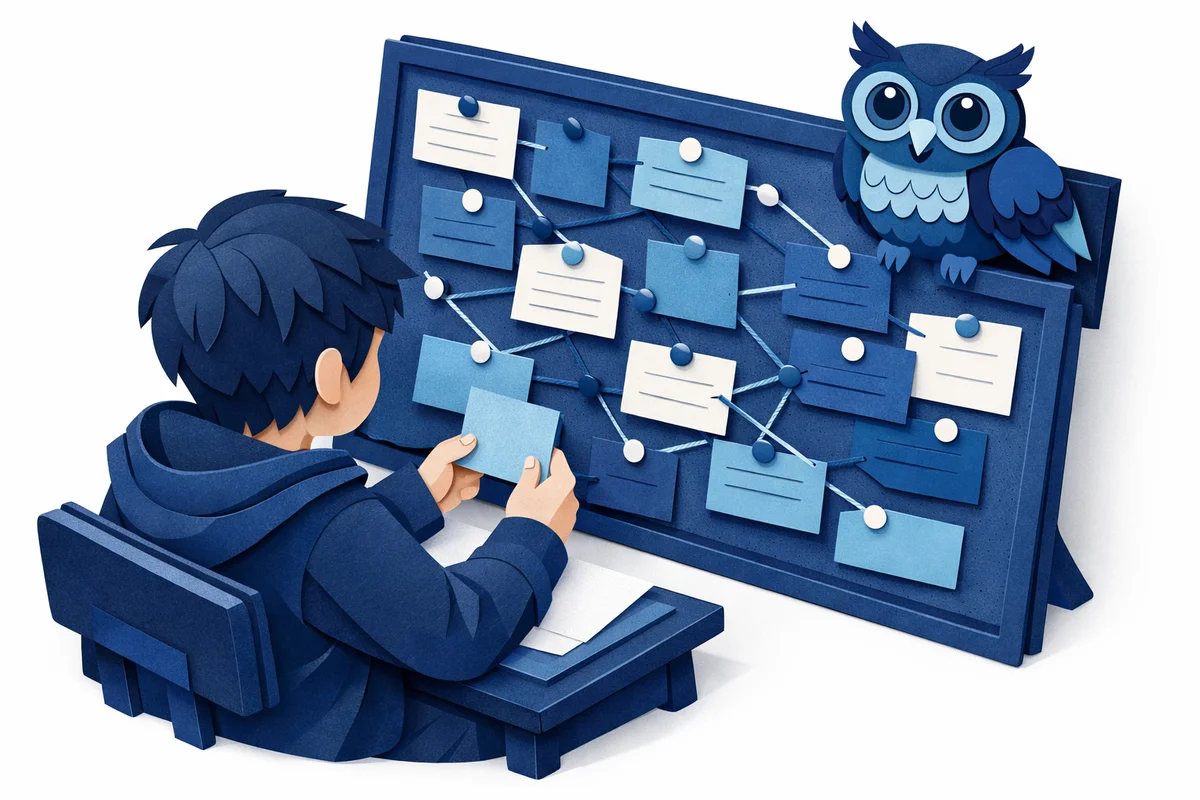
The 12 rules at a glance
Each rule links to the section that explains it. If you only have five minutes, read the rules and copy the checklist.
Decide the quiz's job before you write item one
Measurement, learning, entertainment, and segmentation need different rules. Pick one primary goal.
Plan the difficulty mix before you write
Decide roughly how many easy, medium, and hard items you want, and which objectives they cover.
Match the question type to what you want to measure
Multiple choice is the default, not the only answer. Format is part of the measurement.
Make the stem stand on its own
Cover the options. If the question still makes sense and asks something specific, the stem works.
Ask a direct question, not an incomplete sentence
Sentence-completion stems produce awkward options and grammatical giveaways.
Put the context in the stem and keep options short
Long options turn a knowledge test into a working-memory test.
Give every distractor a reason to exist
Each wrong option should be a mistake somebody actually makes, for a reason you can name.
Use three options before you reach for four
The research says three is usually enough. A fourth option is only worth it if it is genuinely plausible.
Move from "what is" to "what would you do"
Application items tell you whether someone can use the concept, not just recognize it.
Strip wording that advantages some readers
Double negatives, undefined acronyms, and heavy reading load measure the wrong thing.
Decide scoring and feedback before you finalize items
Partial credit, accepted spellings, and explanations all change how a question should be written.
Review, pilot, then retire weak items with data
Self-check, one peer reviewer, a small pilot, then fix the items with extreme results first.
Start with the quiz goal (because it changes the rules)
"Great" quiz questions are questions that do what you need them to do. Before you write item #1, decide which of these outcomes you care about most:
- Measure knowledge accurately (courses, certification practice, hiring screens)
- Build skill and retention (training, onboarding, compliance refreshers)
- Entertain and keep people playing (trivia nights, social quizzes)
- Segment or recommend (marketing lead quizzes, product fit)
That decision affects everything: tone, acceptable difficulty, whether you allow "near misses," how much feedback you show, and how you score.
If your quiz is part of a course or assessment program, align questions to objectives and coverage first, then write items. A small blueprint (topic by difficulty) prevents a quiz from over-testing one narrow area.
Plan the difficulty mix before you write
Difficulty is a property of the whole quiz, not of individual items, and it is much easier to plan than to retrofit. Sketch a rough distribution before you start writing, then write to fill it:
- Warm-up items (roughly the first fifth): Questions most prepared people will get right. These establish the topic and stop early abandonment.
- Core items (the bulk): The questions that actually discriminate between people who know the material and people who do not. This is where your effort belongs.
- Stretch items (a small minority): Harder application questions. Keep these away from the very start, and away from the very end if completion matters to you.
Two practical rules follow from this. First, put your hardest items in the middle, where people are already committed rather than deciding whether to begin or rushing to finish. Second, if an objective matters, give it more than one item. A single question is a coin toss dressed up as a measurement, and one ambiguous item can flip an entire objective's result.
A high-quality question is clear (one interpretation), fair (no unintended advantage), targeted (measures the intended skill/knowledge), and useful (the result leads to a decision: pass/fail, next lesson, recommendation, or insight).
Pick the right question type (not everything should be multiple choice)
Most item-writing advice assumes multiple choice, because it is efficient to grade and easy to standardize. But question type is part of the measurement. Pick formats that match what you want to learn about the quiz taker.
| Question type | Best for | Watch out for |
|---|---|---|
| Multiple choice (single correct) | Broad coverage, consistent scoring, diagnostics via distractors | Weak distractors, "test-taking tricks," cueing the answer |
| Multiple select (choose all that apply) | Complex concepts with multiple correct elements | Ambiguous instructions; scoring confusion (all-or-nothing vs partial credit) |
| True/false | Quick checks, misconceptions, simple facts | High guessing rate; tends to overemphasize trivia |
| Short answer / fill-in | Recall without cueing; terminology; calculations | Spelling variants; multiple valid phrasings; harder to auto-grade |
| Matching | Vocabulary pairs, classifications, "which goes with which" | Too easy if only one pair is unfamiliar; can become pattern-based |
| Scenario-based (any format) | Application, judgment, procedure selection, troubleshooting | Reading load; irrelevant details; unintentionally multiple best answers |
One practical constraint worth checking early: whatever tool you build in has to support the format you picked, or you will quietly redesign the question to fit the editor. In Quiz Maker you can expand a question into any of 38+ types, including matching grids, drag-and-drop, hotspot and image-answer items, so the format choice can follow the measurement rather than the other way round. If you are still deciding how to assemble the quiz itself, the walkthrough on building a quiz step by step covers the settings that affect question design.
If your primary goal is recommendations or segmentation, question types often shift toward preferences and self-report. In that case, design for clarity and consistency (so your outcomes are stable), not "one correct answer."
Write clear stems: one task, one meaning, no scavenger hunt
The stem is the question prompt (everything before the options). A strong stem lets a prepared person answer before reading the choices.
Use the cover-up test
One simple quality check is the "cover-up test": hide the options and ask, "Does the stem stand on its own, and does it ask a specific question?" This is widely recommended in assessment writing because it reduces ambiguity and cueing.
Washington University's guidance explicitly recommends the cover-up test for clarity in assessment items (Writing Assessment Questions (Washington University in St. Louis CME)).
Prefer direct questions over incomplete statements
Incomplete statements ("The process of photosynthesis is...") tend to produce awkward options and grammatical giveaways. Direct questions are easier to read and harder to game.
Put the problem in the stem, not in the options
Long, complex options create a working-memory test instead of a knowledge test. If the question needs context, put the context in the stem and keep options short.
| Weak stem | Improved stem | Why it is better |
|---|---|---|
| "Which of the following is NOT true about password security?" | "Which practice best improves password security?" | Removes negative wording; focuses on selecting the best practice. |
| "Data retention policies are important because..." | "Why do organizations use data retention policies?" | Direct question; options can be parallel and concise. |
| "What is the best answer?" (after a long scenario with no specific ask) | "Given the scenario, what is the first action you should take?" | Clarifies the task (first step) so "best" has a clear meaning. |
Context: (1-2 lines, only what is needed)
Task: "What should you do next?" / "Which statement best explains...?" / "What is the most likely cause?"
Constraint: "Assume..." / "Select one." / "Choose the best answer."
Design answer options: plausible distractors and one best answer
In a scored knowledge quiz, the options are part of the measurement. Weak options turn your quiz into a reading of hints.
Rules that prevent common multiple-choice failures
- One best answer: Avoid items where two options could be defended by a knowledgeable person.
- Mutually exclusive options: Options should not overlap ("A and B" plus "B and C").
- Parallel structure: Similar grammar, length, and specificity reduces unintended cues.
- Plausible distractors: Wrong answers should represent common mistakes, misconceptions, or realistic alternatives.
The University of Minnesota's item-writing guidelines emphasize writing plausible, mutually exclusive distractors and avoiding cues that make the correct option stand out (How to Write Test Questions (University of Minnesota)).
How many options should you use?
Fewer than most people expect. Rodriguez's meta-analysis of 80 years of research, published in Educational Measurement: Issues and Practice, concluded that three options are generally optimal for multiple-choice items. Cutting from four or five options to three did not damage the psychometric quality of the scores, and it let more items be administered in the same testing time, which improved content coverage (Rodriguez, 2005).
The practical reading of that finding is not "always write exactly three." It is that a fourth option has to earn its place. Most writers can produce two genuinely plausible distractors and then pad. If your fourth option is filler that nobody selects, it is adding reading time and no information, and you are better off deleting it and spending the effort on the two distractors that are doing real work.
Be careful with "All of the above" and "None of the above"
These can be valid, but they change what you are testing:
- All of the above can reward partial knowledge (recognizing two true statements may reveal the answer).
- None of the above can reduce diagnostic value (you do not learn what misconception the learner had).
| Goal | Weak distractors (avoid) | Better distractors (aim for) |
|---|---|---|
| Test a procedure step | Jokes, impossible options, or unrelated terms | Realistic wrong next steps that reflect common mistakes |
| Test a concept | One option is much longer/more detailed than the others | Options are similar length, same category, same level of specificity |
| Avoid cueing | Absolute words ("always," "never") only appear in wrong options | Consistent language across options; absolutes only when truly correct |
A complete worked example, option by option
The rules above are easier to apply against a finished item than in the abstract. Here is one complete question, with the reasoning behind every option spelled out.
Stem: A new employee emails a customer list to their personal address so they can work on it at home. You find out an hour later. What should you do first?
| Option | Status | Why it is there |
|---|---|---|
| A. Delete the email from the mail server | Distractor | Feels decisive, which is exactly why people pick it. It also destroys the audit trail an investigation needs. Tests whether the learner values evidence over tidiness. |
| B. Report it to your data protection lead | Correct | The only option that starts the process the policy actually requires. Everything else is a step that comes after, or instead of, reporting. |
| C. Ask the employee to delete their copy | Distractor | The most common real-world instinct, and the strongest distractor for that reason. It addresses the copy but not the breach, and it relies on an unverifiable promise. |
| D. Add a rule blocking personal email domains | Distractor | A genuinely good control, which is what makes it plausible. But it is prevention for next time, not a response to this incident. Tests the difference between remediation and response. |
Notice what makes this item work. All four options are actions a reasonable person might take, and three of them are things people genuinely do, so the item is not solvable by eliminating absurdities. The word "first" in the stem is what makes exactly one answer defensible: without it, C and D are both arguable and the item has no single best answer. And each distractor maps to a specific, nameable misunderstanding, which means the results tell you something. If most people pick C, your team does not understand the reporting duty. If most pick D, they are confusing controls with incident response. That diagnostic value is the entire payoff for writing distractors carefully.
The explanation you would show afterwards writes itself from that table: "Reporting first is what starts the clock on your breach obligations. Asking the employee to delete their copy (C) is worth doing, but only after the incident is logged, and it does not verify anything. Blocking personal domains (D) is a sensible control to add later, not a response to an incident already in progress."
Aim beyond recall: write questions people can learn from
Quizzes are not only measurement tools. Used well, they can also improve learning by strengthening retrieval (remembering) and helping people identify gaps. If you use quizzes for training, build items that make learners think, not just recognize definitions.
Shift from "what is" to "what would you do"
Washington University's assessment guidance recommends emphasizing application of knowledge rather than pure recall when possible (Writing Assessment Questions (Washington University in St. Louis CME)).
Start with the real-world decision
What action, diagnosis, classification, or next step would a competent person choose?
Write a minimal scenario
Add only the details needed to make the decision. Remove "story" details that do not affect the answer.
Make wrong options reflect real errors
Use distractors that a partially trained person might choose for a specific reason.
Example: recall vs application
Recall item: "What does SLA stand for?"
Application item: "A customer reports a critical outage. Which SLA metric determines the maximum allowed time to restore service?"
The application version is usually more informative: it checks whether the learner can use the concept, not just expand an acronym.
The honest problem with application items is that they take much longer to write than definition items. Each one needs a scenario, a defensible single answer, and three distractors that each represent a real error. If you already have the source material (a procedure document, a slide deck, a policy PDF), you can let AI draft the first pass of the questions from it and spend your own time where judgment actually matters, which is strengthening the distractors and checking that only one answer survives scrutiny.
Avoid bias and confusion: wording, assumptions, and accessibility
Bad questions do not just frustrate people. They can systematically disadvantage certain groups (different language backgrounds, different cultural context, or different job roles) and reduce the validity of your results.
Remove ambiguity and double meanings
Survey methodologists have studied question wording more systematically than almost anyone, and the findings transfer directly to quiz items. Pew Research Center's methodology guidance shows how easily respondents interpret identical wording differently, especially with complex phrasing or undefined terms (Writing Survey Questions (Pew Research Center)).
- Define acronyms the first time they appear (unless you are explicitly testing the acronym).
- Avoid double negatives ("Which is not uncommon?").
- Avoid "always/never" unless the domain truly has absolutes.
Avoid double-barreled questions (asking two things at once)
Double-barreled questions force a test taker to guess which part you care about. UC ANR's program-evaluation guidance on question wording calls this out directly as a common pitfall (Writing Good Questions (UC ANR)).
Example (avoid): "Which policy best improves security and reduces support tickets?" (security and support may not align)
Rewrite: Split into two items, or specify the priority: "Which policy best improves security, even if it increases support tickets?"
Accessibility checks (quick but high impact)
- Reading load matches the skill: Do not turn a safety-procedure quiz into a reading-comprehension quiz.
- No "gotcha" punctuation: Avoid tricky capitalization, stray commas, or subtle wording traps.
- Consistent units and formats: If you use dates, pick one format (for example 2026-08-25) and stick with it.
- Keep references self-contained: Avoid "As mentioned above" or "In the previous question..." unless you are intentionally testing a chain.
Feedback and scoring: explanations, partial credit, and what you are rewarding
Feedback design is part of question design. If you plan to show explanations, you can write more challenging questions because the quiz itself becomes a learning moment.
Write explanations like mini-coaching
- Confirm the correct rule: "Correct: You should isolate the device before rebooting."
- Explain why the distractor is wrong: "Rebooting first can destroy logs needed for troubleshooting."
- Add a "next step" link or reference (if you have internal training content).
Decide scoring before you finalize items
Scoring rules can change how "fair" a question feels:
- Multiple select: Will you require all correct options? Will you give partial credit? State it clearly.
- Short answer: Will you accept synonyms, alternate spellings, or case-insensitive matches?
Settle these before you finalize items, because the answers change what you should write. In Quiz Maker the decisions are concrete ones you make before publishing: mark the correct answers, assign points, and choose the pass threshold. If a simple pass or fail is too blunt for your audience, define grade bands instead. And when an item genuinely needs human judgement, such as an open text response, you can keep that one in manual review while every objective question continues to score automatically. Knowing which of those you will use tells you whether an item can be short answer at all, or whether it has to become multiple choice to stay gradeable at your volume.
The stakes decide how strict you should be. A quiz for engagement can forgive a lucky guess; a pass mark on a compliance test cannot, which is why those usually sit at 85 to 90% with a mandatory retake on any missed critical item.
Review and revise: a simple workflow that catches most bad items
Even experienced writers produce ambiguous items. The difference is that experienced teams run a review cycle.
Self-check with a rubric
Run a fast checklist: clarity, one best answer, plausible distractors, and alignment to the objective.
Peer review (at least one other person)
Ask a reviewer to: (1) answer without seeing options, and (2) explain why each distractor is wrong. If they cannot, rewrite.
Pilot with a small sample
Even 5-10 attempts will surface confusing wording and unexpected interpretations.
Fix the worst offenders first
Prioritize items with extreme results (everyone right, everyone wrong, or one distractor attracting most answers).
Use performance data to spot bad questions
You do not need psychometrics software to make meaningful improvements. Start with three signals:
| Signal | What it often means | What to do |
|---|---|---|
| Too easy (very high % correct) | Item may be measuring recognition, not understanding; distractors are weak | Strengthen distractors, increase application, or keep it as a confidence-builder (intentionally) |
| Too hard (very low % correct) | Content may be untaught, stem is unclear, or multiple answers seem right | Check alignment, rewrite stem, validate the key, remove irrelevant details |
| Non-functional distractor (almost never chosen) | Distractor is obviously wrong or out-of-category | Replace with a plausible misconception or reduce the number of options |
You also do not need to export anything to get started. If you run the quiz in Quiz Maker, results update as soon as someone submits, and the question-level breakdown is built to surface exactly the first two signals above: the items that were too easy, too hard, or simply unclear. Export to CSV when you want the data elsewhere, or when you want to track the same item across several cohorts rather than one sitting.
Over time, treat your question bank like a product: monitor items, revise, and keep a changelog for each question so you know what improved results. An item that has survived three cohorts without a complaint is worth more than a new one, and a question you rewrote should be tagged as changed so you do not compare its new results against its old ones.
Trivia and engagement quizzes: making questions harder without making them obscure
Trivia, marketing, and social quizzes have a different success metric: completion rate and enjoyment matter more than strict measurement. That does not mean "anything goes." The best engagement quizzes still follow core quality rules: clarity, single interpretation, and fair options.
Difficulty should come from precision, not obscurity
This is the single most useful idea in trivia writing, and the one most often got wrong. A question is not hard because the fact is rare. It is hard because of how precisely you have to know the fact to answer. Obscurity makes a question unanswerable, which is not the same as difficult, and unanswerable questions are what make people quit.
The same underlying fact can be pitched at three completely different difficulties by changing only the retrieval path:
| Level | Question | What changed |
|---|---|---|
| Easy | "Which planet is closest to the Sun?" | Direct recall of a fact most people were taught. Nearly everyone who knows the topic gets it. |
| Medium | "Which planet has the shortest year?" | Same fact, one inference away. You need to connect orbital distance to orbital period. |
| Hard | "Which planet completes an orbit in 88 Earth days?" | Same fact, but now it requires a specific figure rather than a relative comparison. |
All three have the same answer, and none of them is obscure. Compare that with "What is the mean orbital eccentricity of Mercury?", which is harder only in the sense that almost nobody can answer it. The first three make a player feel they nearly had it. The fourth makes them feel the quiz is not for them.
Three more levers for difficulty that do not rely on obscurity
- Tighten the distractors, not the fact: "Which planet is closest to the Sun?" with Mercury, Venus, Earth, Mars is easy. The same stem with Mercury, Venus, and two other inner-system bodies is meaningfully harder without changing what is being asked.
- Ask for a superlative instead of a member: "Name a country that borders Brazil" is easy because many answers work. "Which country shares the longest border with Brazil?" needs the full picture, not one fragment of it.
- Add a constraint that rules out the easy answer: "Which element has the highest melting point, excluding carbon?" forces the player past the first thing that comes to mind.
Common engagement pitfalls (and better alternatives)
- Obscure facts with no payoff: Replace "who cares?" details with well-known anchors and one interesting twist.
- Trick questions: Use misdirection sparingly. If the fun depends on trickery, many users will churn.
- Time-sensitive trivia: If answers can change (records, rankings, prices), include a date or avoid the item.
- Front-loading the hardest item: A brutal question one keeps people from ever reaching question two. Open with something most players will get right.
Once the questions are written, a purpose-built trivia quiz maker with question examples handles the pacing and scoring conventions that entertainment quizzes rely on.
Borrow patterns from proven quizzes
When you need inspiration for structure (not for copying content), review real-world implementations across industries. The quiz templates and examples gallery is useful for seeing how different teams balance clarity, pacing, and tone.
The 12-point checklist (copy/paste)
One line per rule. If an item fails any of these, it is faster to rewrite it than to defend it.
- 1. Goal match: I know whether this quiz is measuring, teaching, entertaining, or segmenting, and this item serves that goal.
- 2. Difficulty slot: This item has a deliberate place in the easy/core/stretch mix, and hard items sit in the middle.
- 3. Format fits: The question type matches what I am trying to measure, not just what is quickest to grade.
- 4. Cover-up test passes: With options hidden, the stem still makes sense and asks a clear question.
- 5. Direct question: The stem is a question, not a sentence the options have to complete grammatically.
- 6. Context is in the stem: Options are short and parallel; no option is carrying setup the stem should have carried.
- 7. Every distractor has a reason: I can name the specific mistake each wrong option represents.
- 8. No filler options: Three strong options beat four with one throwaway. Any fourth option is genuinely plausible.
- 9. One best answer: If two answers could be defended by a knowledgeable person, I have rewritten until only one is best.
- 10. No hidden assumptions: Terms, units, acronyms, and time frames are defined or universally understood for this audience.
- 11. Scoring decided: I know the points, the pass rule, partial credit, and accepted spellings before this item ships.
- 12. Review planned: One other person has answered it cold, and I know which result would make me revise it.
References
- Washington University in St. Louis CME. (n.d.). Writing Assessment Questions.
- University of Minnesota - University Survey & Assessment Services. (n.d.). How to Write Test Questions.
- Rodriguez, M. C. (2005). Three Options Are Optimal for Multiple-Choice Items: A Meta-Analysis of 80 Years of Research. Educational Measurement: Issues and Practice, 24(2), 3-13.
- Pew Research Center. (n.d.). Writing Survey Questions. (Survey methodology; cited here for question-wording and ambiguity.)
- University of California ANR - Program Evaluation. (n.d.). Writing Good Questions. (Program evaluation; cited here for double-barreled wording.)
Frequently Asked Questions
How many answer options should a multiple-choice question have?
Three is usually enough. Rodriguez's meta-analysis of 80 years of research found three options generally optimal, with no loss of score quality compared with four or five. Write a fourth option only when it is genuinely plausible. If your extra option is an obvious throwaway, delete it and strengthen the distractors that remain.
Is it OK to use "None of the above"?
Sometimes. It can work when you are explicitly testing whether the learner can recognize that all listed options are incorrect. But it reduces diagnostic value (you do not learn what they believed) and can turn the item into a strategy game. If you use it, use it sparingly and make sure the stem is crystal clear.
How many questions should a quiz have?
It depends on the goal. For engagement quizzes, aim for a length people will finish (often 6-12 items). For training checks, use enough items to sample each objective (often 10-25). For higher-stakes testing, increase coverage and reliability by adding items per objective and balancing difficulty. When in doubt, pilot: if completion drops, shorten or improve pacing.
How do you make a trivia question harder without making it obscure?
Change how precisely the answer has to be known, not how rare the fact is. "Which planet is closest to the Sun?" is easy, "Which planet has the shortest year?" is one inference harder, and "Which planet completes an orbit in 88 Earth days?" is harder still. All three have the same answer and none is obscure. You can also tighten the distractors, ask for a superlative rather than any valid member of a set, or add a constraint that rules out the obvious answer.
What is the quickest way to improve weak quiz questions?
Run the cover-up test on stems, remove negative/tricky wording, and replace any distractor that almost nobody picks. Then pilot again with a small sample and add short explanations for the highest-missed items.
